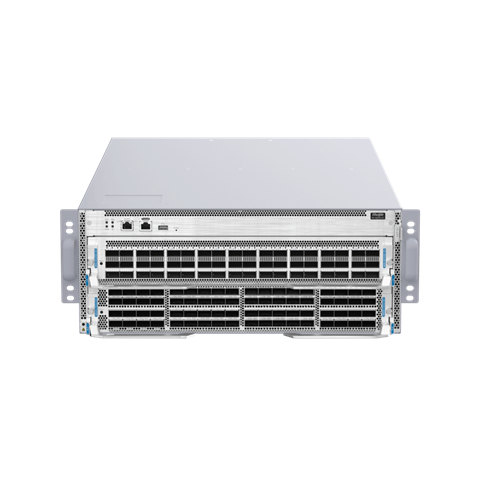
Hardware Specifications
| System Specifications | RG-S6930-2C | |
| Switching Capacity | 28.8 Tbps | |
| Packet Forwarding Rate | 5400 Mpps | |
| Port Specifications | RG-S6930-2C | |
| Ports | 100GE/200GE ports | |
| Expansion Slots | Two, each slot supporting up to 72 × 100GE ports or 36 × 200GE ports | |
| Expansion Modules | Four power module slots, supporting 2+2 redundancy
Eight fan module slots, supporting 7+1 redundancy |
|
| Management Ports | One management port, one Console port, and one USB port | |
| Dimensions and Weight | RG-S6930-2C | |
| Dimensions (W × D × H) | 442 × 760 × 175 (17.40 in. × 29.92 in. × 6.89 in.), 4 RU | |
| Weight | 33.55 kg (73.97 lbs., including eight fan modules and four power supply modules) | |
| Power Supply and Consumption | RG-S6930-2C | |
| Input Voltage | AC | ● Rated voltage range: 200 V AC to 240 V AC
● Frequency: 50 Hz to 60 Hz ● Rated input current: 9.5 A (max) |
| HVDC | ● Rated voltage: 240 V DC
● Rated input current: 9.5 A |
|
| Maximum Power Consumption | < 2900 W | |
| Environment and Reliability | RG-S6930-2C | |
| Operating Temperature | 0ºC to 40ºC (32ºF to 104ºF) | |
| Storage Temperature | –40ºC to +70ºC (–40ºF to +158ºF) | |
| Operating Humidity | 10% to 90% RH (non-condensing) | |
Software Specification
| Software Specification | RG-S6930-2C |
| 802.1Q VLAN | 4094 |
| L2 Protocols | IEEE802.3ad (Link Aggregation Control Protocol), IEEE802.1p, IEEE802.1Q, IEEE802.1D (STP), IEEE802.1w (RSTP), IEEE802.1s (MSTP), IGMP Snooping, MLD Snooping, Jumbo Frame (9 KB), IEEE802.1ad (basic QinQ and *selective QinQ), and GVRP |
| L3 Protocols
(IPv4) |
BGP4, OSPFv2, IS-IS, RIPv1, RIPv2, MBGP, LPM Routing, Policy-based Routing, Routing Policy, ECMP, WCMP, VRRP, IGMP v1/v2/v3, PIM-SSM/SM/DM, MSDP, and Any-RP |
| Basic IPv6 Protocols | Neighbor Discovery, Path MTU Discovery, DNSv6, DHCPv6, ICMPv6, ICMPv6 redirection, ACLv6, TCP/UDP for IPv6, SNMP v6, Ping/Traceroute v6, IPv6 RADIUS, Telnet/SSH v6, FTP/TFTP v6, NTP v6, IPv6 MIB support for SNMP, VRRP for IPv6, and IPv6 QoS |
| IPv6 Features | Static routing, ECMP, PBR, BGP4+, OSPFv3, IS-ISv6, RIPng, MLDv1/v2, PIM-SMv6, manual tunnel, *automatic tunnel, IPv4 over IPv6 tunnel, and * ISATAP tunnel |
| Visualization | gRPC
sFlow and IPFIX sampling |
| QoS | 802.1p, DSCP, and ToS priority mapping ACL-based traffic classification Priority marking and remarking Queue scheduling mechanisms, including SP, WFQ, and SP+WFQ |
| HA Design | GR for RIP/OSPF/BGP, BFD, REUP dual-link fast switching, RLDP unidirectional link detection, 2+2 power redundancy, fan redundancy, and hot swapping for all line cards and power supply modules |
| Security Features | MACSec, Network foundation protection policy (NFPP), CPU Protection Policy (CPP), DDoS attack defense, unauthorized data packet detection, source IP spoofing prevention, IP scanning prevention, RADIUS/TACACS, IPv4/v6 packet filtering by basic ACL, extended ACL or VLAN-based ACL, plaintext-based and MD5 authentication for OSPF, RIPv2, and BGPv4 packets, uRPF, broadcast packet suppression, Telnet login and password mechanisms for restricted IP addresses |
| Management Modes | SNMP v1/v2/v3, Telnet, Console, MGMT, RMON, SSHv1/v2, FTP/TFTP, NTP, syslog, and SPAN/RSPAN/ERSPAN |
| Other Protocols | DHCP Client, DHCP Relay, DHCP Server, DNS Client, UDP Relay, ARP Proxy, and Syslog |
| *MPLS | MPLS L3VPN, SR, and SRv6 |